Parts of a CPU and Their Functions
By Marlo Strydom · Published
A processor is much easier to understand once you stop picturing it as one solid chip. Inside that small square are separate units that each do one job. One reads the instructions, one does the math, one holds the values being worked on, and several layers of fast memory keep all of them supplied with data.
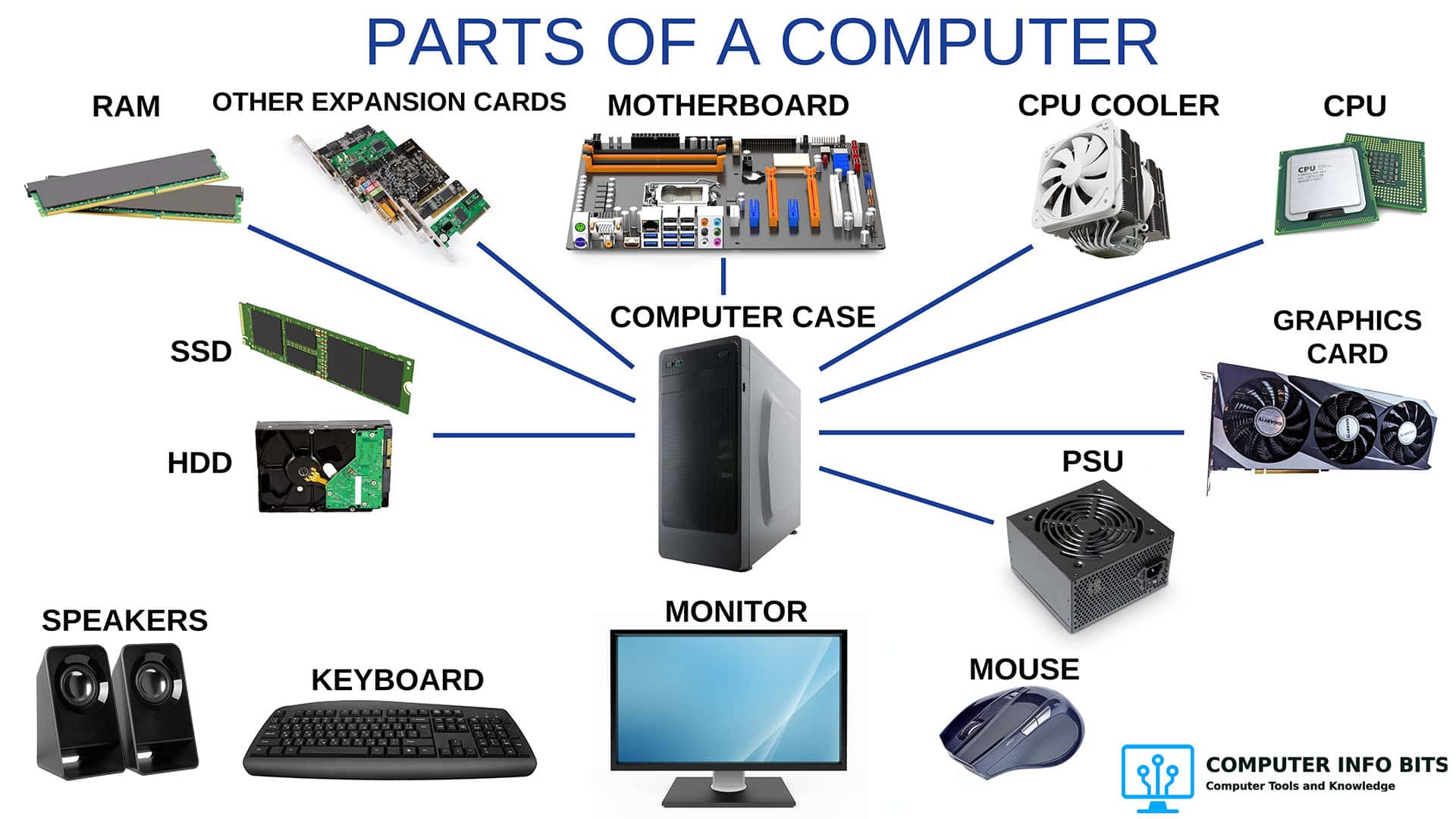
This guide walks through each part in the order the processor actually uses it, then opens up the physical package to show where those parts live. If you want the wider picture first, start with the main parts of a computer.
What the CPU Does
The central processing unit runs the instructions that make up every program on the computer. It does not decide what those instructions mean in a human sense. It repeats a very simple loop billions of times each second: collect an instruction, work out what it asks for, carry it out, then store the result.
Almost everything else inside the chip exists to keep that loop from stalling. Waiting on memory is the main thing that slows a processor down, which is why so much of the space inside a modern CPU is given to cache rather than to math.
Parts of a CPU at a Glance
Control Unit
The control unit is the part that reads each instruction and works out what it is asking for. It does no math itself. Its job is to fetch the next instruction, decode it into steps the hardware understands, then switch on whichever units are needed and route the data to them.
It also keeps track of where the program is up to, so the processor knows which instruction to collect next. When a program branches, such as when an if statement goes one way instead of another, the control unit is what redirects the flow.
Arithmetic Logic Unit
The arithmetic logic unit, usually shortened to ALU, is where the actual work happens. It handles two kinds of operation. Arithmetic covers addition, subtraction, and the multiplication and division built on top of them. Logic covers comparisons and true or false tests, such as checking whether two values match or which of them is larger.
Those simple operations are enough to run every program on your computer. Sorting a list, scaling an image, and checking a password all come down to long sequences of arithmetic and comparisons.
Worth knowing: Modern cores contain several ALUs plus separate units for decimal numbers and for repeating the same operation across many values at once. That is why a core can finish more than one instruction per clock tick instead of being limited to a strict one at a time.
Registers
Registers are the small slots of storage built directly into the core. They hold the few values the processor is working with at this exact moment, and they are the fastest storage in the entire computer because they sit right next to the units that use them.
There are only a limited number of them, and each holds a small amount of data. Their speed comes from being close and few. Anything that will not fit in a register has to be pulled in from cache or memory, which always takes longer.
Cache Memory
Cache is a pool of fast memory that sits between the registers and system RAM. The processor keeps recently used instructions and data here, because a program that just used a piece of data is very likely to want it again shortly. Cache is arranged in levels, and each step outward is larger but slower than the one before it.
| Level | Where It Sits | What It Holds |
|---|---|---|
| L1 | Inside each core, split between instructions and data | The smallest and fastest pool, checked first on every access. |
| L2 | Also private to each core, one step further out | A larger backup for data that no longer fits in L1. |
| L3 | Shared across all the cores on the chip | The largest pool, and the last stop before a request goes to RAM. |
When the processor finds what it needs in cache, the work continues with almost no delay. When it does not, the request has to travel out to RAM and the core may sit idle while it waits. Cache size is listed in the published processor specifications alongside core count and clock speed, and it is one reason two chips at the same frequency can perform very differently.
The Clock
The clock is a signal that pulses at a steady rate and keeps every part of the processor working in step. Each pulse marks the point at which the next stage of work can begin. Clock speed is measured in gigahertz, where one gigahertz means a billion pulses per second.
A higher clock speed means more steps per second, but it is only useful when compared between similar chips. A newer core that finishes more work per pulse can beat an older one running at a higher frequency. Processors also raise and lower their own speed as conditions allow, which Intel describes for its boost behavior and AMD covers in its Precision Boost documentation.
Heat sets the ceiling on all of this. Once a chip reaches its temperature limit it lowers its own clock to protect itself, which Intel confirms when it notes that thermal throttling reduces processor clock speed.
Memory Controller
The memory controller is the part of the CPU that talks to the system memory on the motherboard. It sends the read and write requests, tracks the timing the memory modules need, and hands the results back to the core.
Building this into the processor rather than the chipset shortened the path to RAM and cut the delay on every request that misses cache. It also means the CPU, not the motherboard alone, sets which memory types and speeds a system can use. Memory usually runs below its rated speed until a stored profile is switched on, such as the Extreme Memory Profile settings found in most desktop firmware.
To check yours, our free RAM Optimizer shows each stick's speed and flags any kit running below its rating.
Cores and Threads
A core is a complete copy of everything described so far: its own control unit, ALUs, registers, and L1 and L2 cache. A processor with eight cores has eight of these working side by side, which is what lets a computer run several demanding programs at the same time without them fighting for the same hardware.
Threads are separate from cores. Many processors let a single core hold two threads and switch between them whenever one stalls waiting for data, so the idle gaps get filled with useful work. This is why Windows may report twice as many logical processors as the chip has physical cores. Microsoft documents how to find the core count, and the Performance tab of Task Manager shows both numbers together.
More cores do not help every task. A program written to run as a single sequence uses one core no matter how many are available, which is why some older software feels no faster on a large processor. If you are weighing a CPU against a graphics card, the PC bottleneck calculator gives a starting point for which one limits your setup.
Integrated Graphics
Many desktop and nearly all laptop processors include a graphics unit on the same piece of silicon. It drives the display, handles everyday visual work, and takes over video decoding so the main cores do not have to. Because it has no memory of its own, it borrows a share of system RAM.
This is the part that lets a PC show a picture with no separate graphics card fitted, which is useful when testing a build or diagnosing a faulty card. Not every processor has one, so a chip without integrated graphics needs a card installed before it will produce any display output at all.
The Physical Package
Everything above lives on a single piece of silicon called the die. The die is surprisingly small, and the square you hold in your hand is mostly packaging built around it.
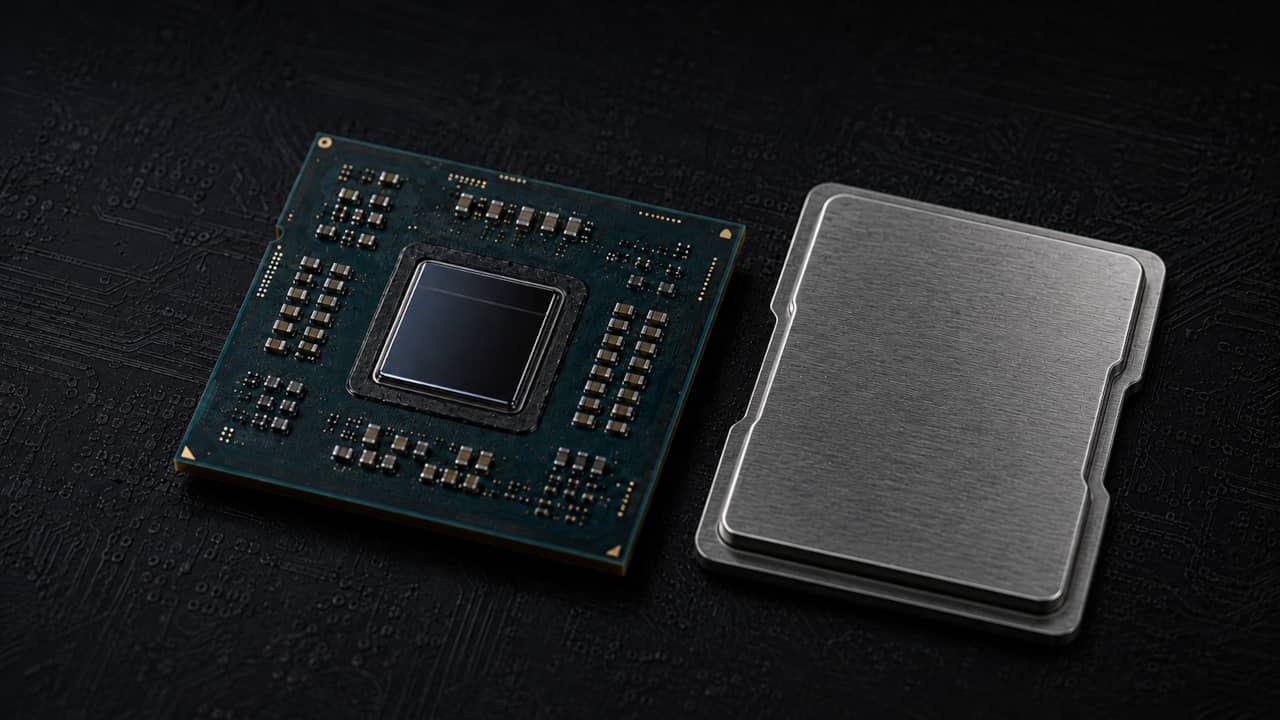
- Silicon die: The chip itself, holding the cores, cache, memory controller, and graphics unit.
- Package substrate: The green board the die sits on, carrying its connections out to the edges.
- Integrated heat spreader: The metal lid that spreads heat from the die across a wider surface for the cooler to collect.
- Contacts: The pads or pins underneath that meet the CPU socket on the motherboard.
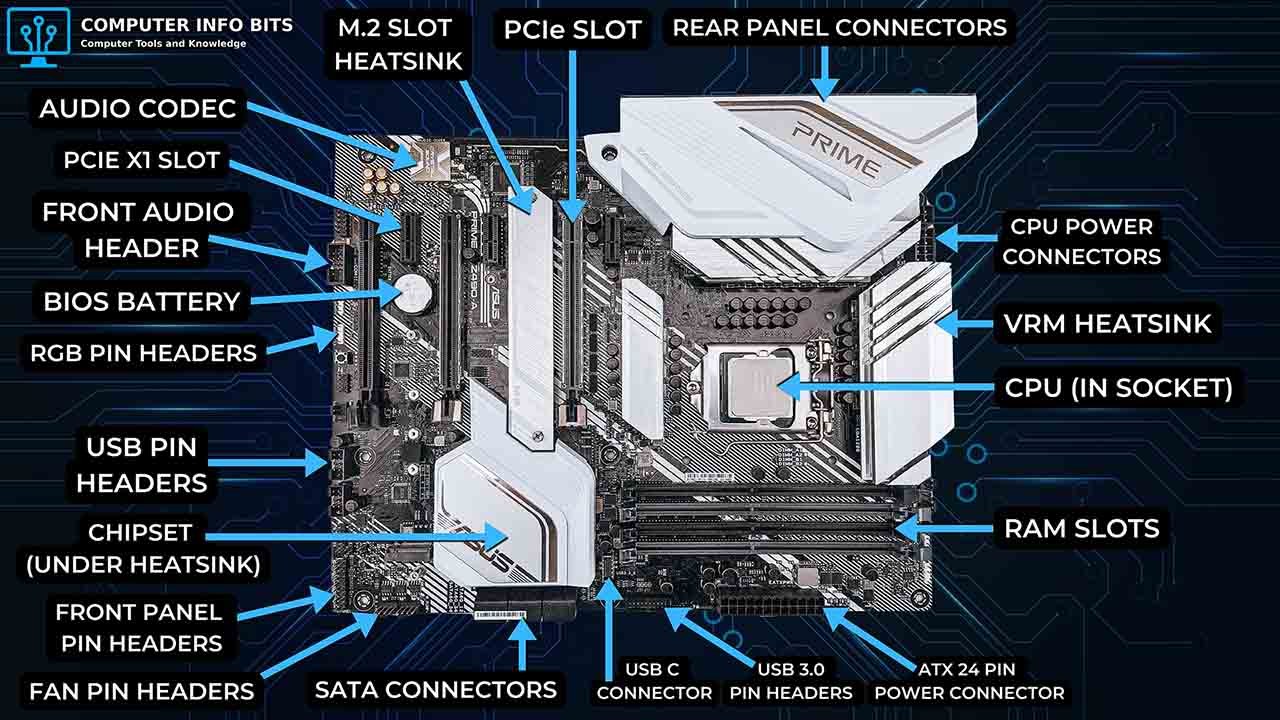
Those contacts are the reason processors need careful handling. Intel's processor installation guide warns against touching them and calls for antistatic protection, because bent or dirty contacts stop a chip from starting even when nothing else is wrong. The socket also decides which processors a board accepts, a point covered in our guide to motherboard parts.
How the Parts Work Together
Each of these units is nearly useless alone. What makes a processor work is the loop they run together, repeated for every instruction in every program:
- The control unit fetches the next instruction, taking it from L1 cache when it is already there.
- It decodes that instruction into the specific steps the hardware can carry out.
- The values needed are loaded into registers, from cache or from RAM through the memory controller.
- The ALU carries out the arithmetic or comparison the instruction asked for.
- The result is written back to a register, then out to cache and memory as needed.
- The clock ticks and the next instruction begins.
Real processors overlap these stages so several instructions are in progress at once, and they reorder work to avoid waiting. The order above is still what every instruction goes through. When a CPU behaves strangely, that shared loop is why a fault in one unit shows up as general instability rather than one broken feature.
Related Posts